Article: What is Selah?
A brief word from us before you read: The Word for the World is dedicated to ending Bible poverty by empowering indigenous communities to lead their own Bible translation projects. Our mission is to ensure that everyone can experience the power of God’s Word in their own heart language. If you share our vision of a world where every nation and tongue has access to the Bible, we invite you to support this mission through your prayers and giving.
What does ‘Selah’ mean in the Bible?

‘Selah’. How many times have you seen that little word as you read through the Psalms? How many times have you wondered what it means? Or has your brain seen it so often that it has created a meaning for you, based on the feelings it evokes when you read it?
In our last article (link), we looked at how translators do their best to translate the original Hebrew and Greek manuscripts of the Bible into versions we can understand today. Each word is carefully studied, and the equivalent word in English (or whatever language it is being translated into), is thoughtfully chosen.
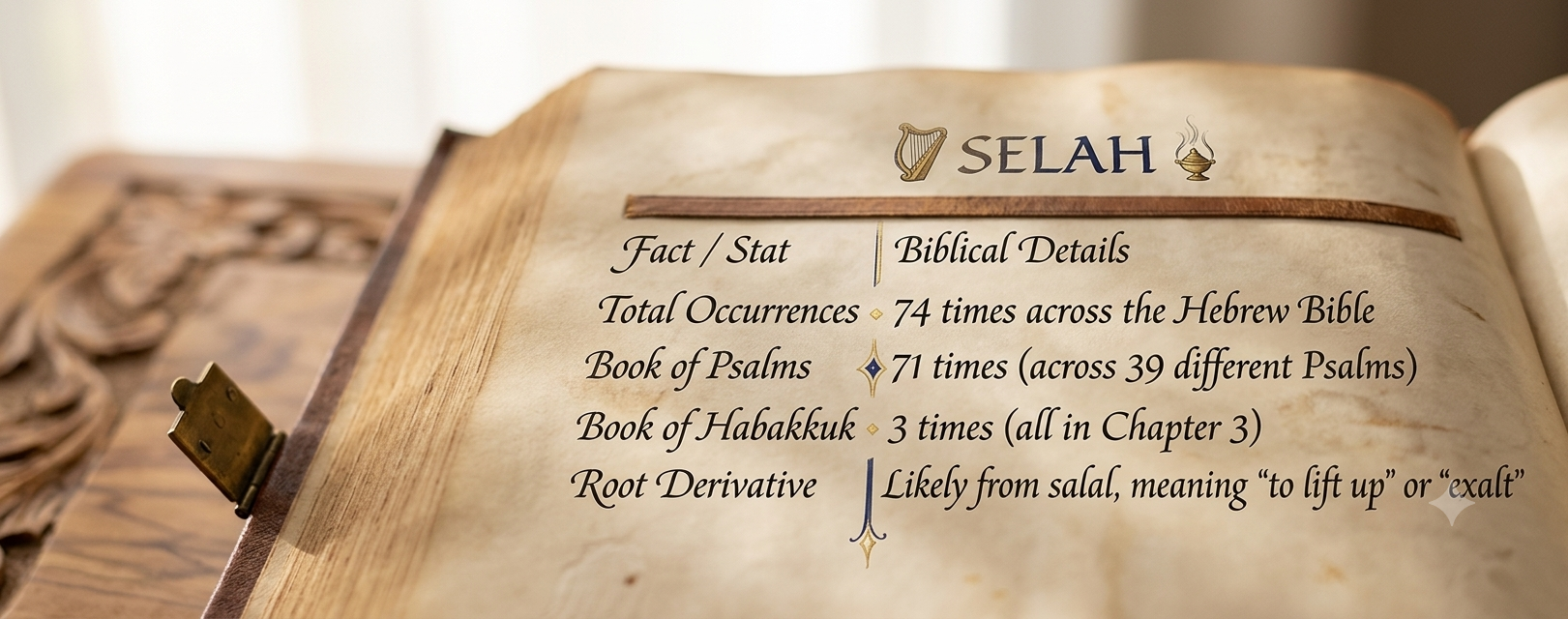
But why is ‘Selah’, which appears 74 times in the Hebrew Bible, never translated?
Well, the short answer is, no one actually knows what it means! Even the ancient translators of the Septuagint (translated around 130 BC) were stumped, translating it, rather unhelpfully, as ‘apart from psalm.’
‘Rare words permeate the Psalter’s pages— including Selah. This obscure word has been deemed the “puzzle of ordinary readers and the despair of scholars”.’ (Logos)
The Translator’s Conundrum
This poses a particular problem, especially for Bible translators such as ours, here at The Word For The World, who spend a lot of time wrestling with particular words or phrases as they translate God’s Word into indigenous heart languages. The word ‘Selah’ is one of a handful of words in the Bible that does not have a direct translation. Like ‘Hallelujah’, or ‘Amen’, ‘Selah’ is a transliteration, which means the letters have simply been changed into another alphabet, keeping the same sounds. But unlike ‘Hallelujah’ and ‘Amen’ the meaning of ‘Selah’ seems to have been lost over time.
‘There are a number of suggested meanings for ‘Selah’, and no one is quite sure of the correct one… So imagine what it’s like for a translator in Congo!’ Steve Lancaster, UK Director of The Word for the World
Why is ‘Selah’ used in the book of Psalms?
So, are there any clues we can find to work out the meaning of this enigmatic word?
Well, ‘Selah’ is used 71 times in the book of Psalms (and then three times in the book of Habakkuk), so it’s safe to assume that the word has musical significance. As the Psalms were the Psalter (or song-book) of God’s people, the Israelites, the term ‘Selah’ clearly has musical origins. Also, thirty-one of the thirty-nine Psalms which have the caption ‘To the choir master’ contain the word ‘Selah’, further strengthening the argument that it is likely a musical directive.
The Psalms are a rich tapestry of musical compositions, with refrains, careful repetition and thematic shifts. It therefore makes perfect sense for them to be punctuated with musical directives to help guide the ancient Israelites as they worshipped – just as we have those all-familiar bridges, choruses and key changes in our sung worship.
But if it’s fairly clear that ‘Selah’ was a form of musical direction, what direction was it giving?
‘While the exact meaning and origins of Selah are difficult to determine, the wide consensus is that it is related to music and musical accompaniment reminds us how significant sung praise is to the worship of God and the life of the believer.’ (Ligonier)

A Moment of Calm Amidst the Storm
One of the ways we can try to determine the form of musical direction ‘Selah’ gave is by looking at where it occurs. It often appears at crucial moments in a psalm where God’s people are crying out to Him for intervention, or declaring His praises.
Consider this portion of Psalm 3:
“ Lord, how many are my foes!
How many rise up against me!
Many are saying of me,
“God will not deliver him.”
Selah
But you, Lord, are a shield around me,
my glory, the One who lifts my head high.
I call out to the Lord,
and he answers me from his holy mountain.”
As we see here, ‘Selah’ is used during an intense outcry to God, and is then followed by a declaration of God’s majesty and power. ‘Selah’ creates a pause; a moment of calm, allowing King David to lift his eyes from his own troubles, to his great Sovereign God. It shifts the focus from his earthly struggles to heaven, where God is enthroned on high.
Indeed, some scholars link ‘Selah’ with the Hebrew root ‘salal’ which means to ‘lift up’ or ‘to raise.’ This ties in beautifully with the idea that many scholars have proposed: that the purpose of ‘Selah’ is to provide a moment of reflection, as worshippers raise their eyes up to God, and in doing so are filled with God’s peace through the reminder that He is completely in control.
‘While ‘Selah’s’ exact meaning may encompass “pause,” “exalt,” or “lift up,” the overall effect is to draw readers and worshipers into deeper contemplation of the LORD’s majesty, mercy, and mighty acts.’ (Bible Hub)
Be Still and Know that I am God
We may not know the exact meaning of ‘Selah’, but we do know our God. His unfailing, ever-loving, faithful character spills from the pages of our Bible.
So, when you next see that little word ‘Selah’ appear amidst a psalm, why not see it as an invitation to quieten your heart and remove distractions, allowing yourself the breathing space that God deserves to focus our eyes upon Him, and to get to know Him better through His Word.
Whether ‘Selah’ means to pause, meditate, or to lift up God’s name – it is all for the same purpose: to give glory to God and to shift our focus completely on to Him, and the great things He has done for us.
‘When encountering ‘Selah’… treat it as an invitation to marvel at God’s work in creation, salvation, and providential care. Such reflection aligns with an overall biblical practice of remembering, meditating on, and celebrating the Creator’s goodness.’ (Bible Hub)