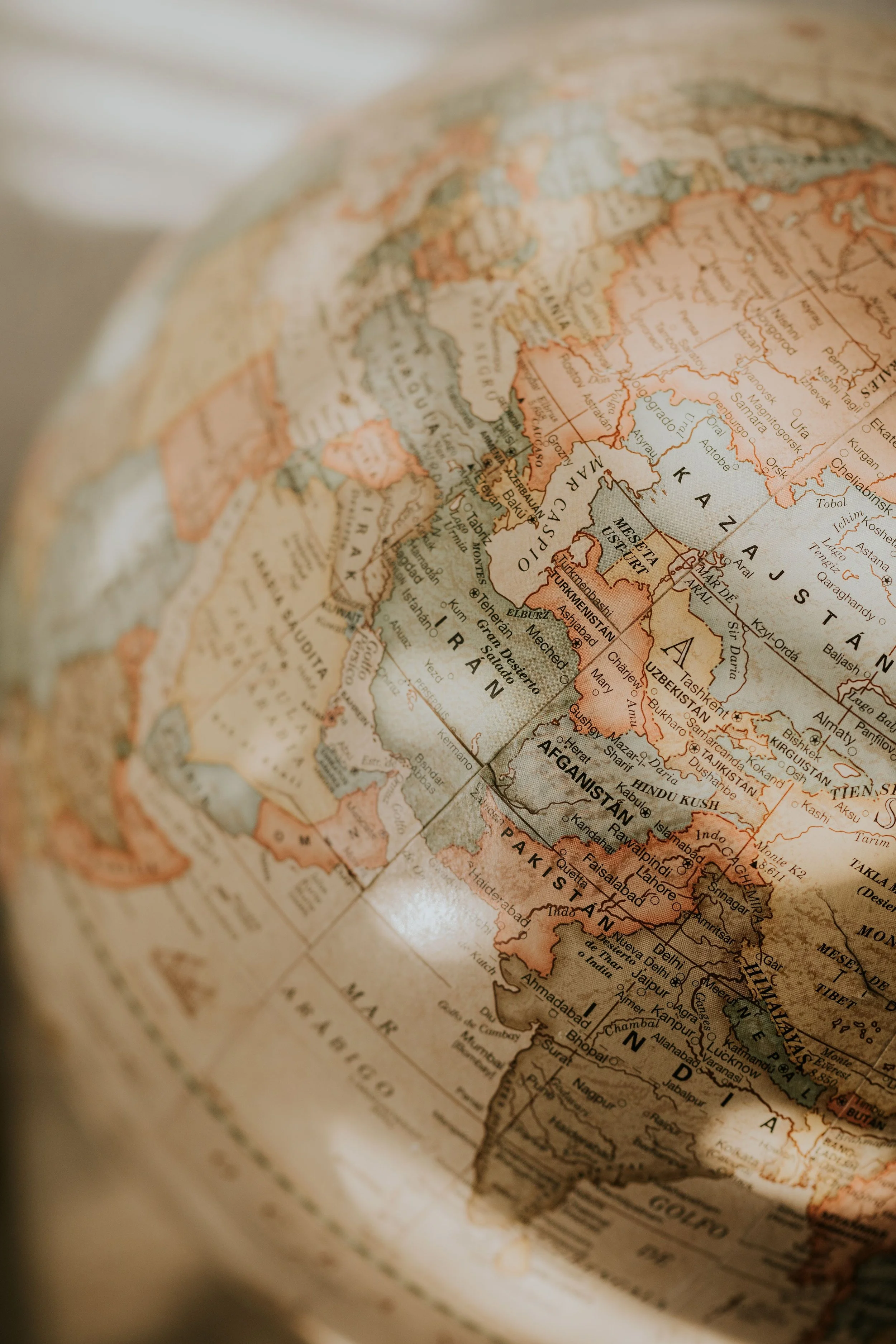
A brief word from us before you read: The Word for the World is dedicated to ending Bible poverty by empowering indigenous communities to lead their own Bible translation projects. Our mission is to ensure that everyone can experience the power of God’s Word in their own heart language. If you share our vision of a world where every nation and tongue has access to the Bible, we invite you to support this mission through your prayers and giving.
The Final Words of Our Lord Jesus - Matthew 28:18-20
We place a great deal of importance on someone’s final words, don’t we? They are often precious gifts, loaded with meaning, and what they want to impart carries great value.
How much time and significance do we devote to the final teachings of Jesus? Having taught his disciples for three years, and then a further forty days after his resurrection, Jesus had one final instruction for his eleven remaining disciples as they surrounded him on a hill in Galilee:
“All authority in heaven and on earth has been given to me. Therefore, go and make disciples of all nations, baptising them in the name of the Father and of the Son and of the Holy Spirit, and teaching them to obey everything I have commanded you. And surely, I am with you always, to the very end of the age." Matthew 28:18-20 NIV
We know the disciples carried out these instructions, often at the cost of their lives, but we also know that this teaching is for us too. So, what is the theological meaning of the Great Commission, and how does it relate to modern mission and Bible translation work today?
The Authority, the Promise and the Assurance
Let’s break Jesus’s final words down to understand exactly what the Great Commission means for us as modern-day Christians.
Firstly, it’s important to note that Jesus does not begin with a command. Just as when God appeared to Moses to give him his calling, Jesus does not begin with instructions, but with a glorious reminder of who He is, and why we can trust him. He says, ‘All authority on heaven and earth has been given to me’, and the Greek word used here is ‘exousia’, meaning ‘right’ or ‘jurisdiction’. Jesus is reminding his disciples that he holds all power over heaven and earth; he is the Sovereign King over all things, so whatever he commands therefore has cosmic legitimacy.
Having made this incredible statement about who he is, which must have greatly encouraged the disciples’ hearts, he then gives his core command: ‘Therefore, go and make disciples of all nations.’ He has told them who he is, so the logical and right thing for them to do is to tell others the wonderful truth about him and his salvation plan.
Now we may think that ‘nations’ refers to modern geo-political nation-states (places), but the Greek word used is ‘ethne’ which actually refers to distinct ethnic, cultural, and linguistic groups (peoples). Ever since the tower of Babel, when God caused his rebellious people to speak in different tongues, humanity has been unable to communicate in one language. But now Jesus is calling his disciples to go to all these scattered language groups and tell them of the saving gospel, which is for all people, in all cultures. They can finally be united through his saving act of redemption. The energy and urgency of the words ‘go’, ‘baptise’, ‘teach’, is palpable – and every one supports the main imperative verb: ‘make disciples’.
Jesus began his teaching by anchoring his disciples in the truth of who he is, and he closes The Great Commission with the promise that: ‘I am with you always, to the very end of the age.’ He is giving them the assurance of his abiding presence through the Holy Spirit, who will remain with them after his ascension (which will take place very soon). The Greek phrase used is ‘synteleia tou aionos’ which describes Christ’s perpetual empowering: he will never leave them in this task that he has appointed them for. What an incredible comfort and encouragement that must have been for them.
In these few short verses, we can see that Christ’s mission is rooted in who he is, and that our own missions and outreach should take place through his empowering, not human initiative. To know that Jesus is always with us as we carry out his commands should give us huge encouragement too, whether we are evangelising here in the UK, or in challenging or hostile environments overseas.
The Word for the World believes that fulfilling Christ’s command requires providing God's Word in every language so that every people group can hear, read, and obey God's truth in their heart language. The Great Commission drives our indigenous Bible translation projects.
“Bible Translation and the Great Commission, for us go very much hand in hand. In fact, we think that Bible translation forms the cornerstone of the Great Commission.
Jesus commissions the disciples – and, I believe, us - to go out into the world and to teach people all that he has commanded. This is why Bible translation is so important. The Bible is the most important book in the whole world. It is a God-breathed book that tells people what they must do to be saved. It points people to Christ, it points people to God, and his plan of salvation. The Holy Spirit breathes through the Scriptures with power to convict people and to lead them to Christ so that they can spend their eternity with him in heaven and the new earth.”
Watch Professor John Lennox talk about the Great Commission, taken from TWFTW UK Vision Day October 2026.
Why the Great Commission Requires Heart Language
If you are able to speak a second language, what is it like reading a book in that language, as compared to the language you learned as a child? A second language naturally takes more time and effort to fully understand, doesn’t it? Whereas our heart language is the language we grew up with. It’s the language we joke and dream in. It’s second nature to us. We can fully understand every word of it.
When the disciples were first called, we are told often in the gospels that they were ‘with’ Jesus. They spent time with him, lived with him, ate with him – and chatted with him, in their heart language. To be an effective disciple requires real understanding, and easy communication. Jesus says in verse twenty that they are to teach people to ‘obey everything I have commanded you.’ This cannot occur effectively through a secondary or poorly understood ‘head’ language.
And yet over 3,000 language groups throughout the world still lack complete Scripture in the language they understand best. That’s 1.5 billion people who have no access to God’s Word in their heart language.
Jesus came down to earth and became one of us so that he could walk and talk with us (John 1 verse 14). So, too, must God’s Word take on the language and culture of every ‘ethne’ (people group). Jesus did not exclude anyone in his mission, and we must not allow language barriers to stop people from hearing the good news of the gospel.
“What is heart language and why is it so important? I think this is hard for us to understand because for the vast majority of us, we have grown up in countries where we have had the English Bible for five hundred years or more. We have always had the Bible in the language we have grown up with. So, I don’t think we fully appreciate what it means to not have the Bible in our heart language.
For example, in Tanzania there are 120 different languages, but only one trade language, which is Swahili. A lot of people would know some Swahili, but it is not their heart language. It is not their tribal language, the language that they dream in, the language that they first learn and understand. To have the Bible in their heart language is key in terms of their being able to fully understand what God’s Word has to say directly to them.”

The Great Commission in Action: How The Word For The World Empowers Indigenous Translators
In 1979, our founder Veroni Kruger felt God say, ‘I want you to establish an indigenous Bible translation agency whose vision will be empowering nationals to translate the Bible for their own people.’ This was an innovative approach; usually Bible translation projects sent in external workers. But by involving local communities in their own Bible translation projects, not only was the work more accurate and more sustainable, it also gave communities ownership of the projects.
We continue to use this unique approach today, which allows us to invest in local communities, provide diploma-level Bible translation training and literacy programmes, and build sustainable translation structures that empower indigenous translators to translate the Bible for their own people. They are able to make disciples in their own nations, allowing their people to be taught all that Jesus has commanded in the languages that they understand best.
We are working to support indigenous teams around the world across hundreds of unreached language groups. In Malawi we recently launched the completed Lambya Bible, and the Nkanagala New Testament, to great rejoicing. In Ethiopia we are supporting twenty-four Bible translation projects among languages such as Gamo, Gedeo, Bench, and Basketo. In Asia we are equipping indigenous teams in over seventy Bible translation projects, and five literacy programmes. In Eastern Europe we are reaching Europe’s oldest minority group—the Romani people—across Slovakia, Serbia, Croatia, and Albania.
We have seen the joy of those who have been waiting for the Bible in their heart language for many years, finally holding their own copy in their hands, and that’s why we want these projects to be completed as soon as possible. As a full Bible can take up to twenty-five years to translate, we have developed AiBT (Artificial Intelligence immersed Bible Translation) to accelerate the initial translation process. By using AI to develop a first draft, we can streamline translators’ time, allowing them to focus on refining meaning and ensuring faithful Scripture translation. With indigenous translators still involved at every step of the way, checking for quality and accuracy, it is estimated that by using this blended approach, translation time can be reduced by 75-80%, allowing us to place Scripture into the hands of people much faster than ever before.
“Over the past 45 years, God has grown The Word for the World from a single project beginning to hundreds of Bible translation projects. Before us now stands a significantly larger season of responsibility. The demand is real. The indigenous-led model is effective. People are being equipped. We have the capacity to meet this demand, and funding will determine how fully and how quickly we can respond.”
We launched the “Sinai for Sena” project and an appeal was made to help TWFTW provide 10,000 Bibles for the Sena people of Malawi.
How the UK Church Can Engage with the Great Commission
We know that Jesus’s Great Commission was not just for the eleven disciples who stood before him on that hillside. It is our challenge and privilege to carry on his commission today, in his strength and for his glory. But what does that look like for us practically?
No matter where you live, or what your situation is, there are impactful ways in which you can help to ‘make disciples of all nations’ today, through the power of the Holy Spirit that works in us.
National Bible translation teams are working in increasingly challenging circumstances around the world. This year, one of our translators was killed for his work in a hostile region. Many teams face persecution, isolation and resource shortages. Our Lord Jesus has reminded us that he has ‘all authority on heaven and earth’, so let us pray intentionally, and intercede for those who are on the frontlines.
For hundreds of years, men and women have supported Bible translation work through Kingdom Stewardship. Nowadays, UK individuals and churches can partner directly with indigenous Bible translation teams in their work to complete New and Old Testaments. There are many Bible projects waiting to start that simply don’t have the funding to do so, and we need the financial support of Christians to allow these vital projects to begin.
Jesus’ Great Commission cannot be fulfilled until all nations have the gospel in their hands. We may live thousands of miles away from many of these Bible translation projects, but we can be active supporters nonetheless.
“Putting Scripture into other languages is perhaps the greatest work anyone can be involved in.”
Stand with Us in Fulfilling the Great Commission
Bible translation serves as the cornerstone for fulfilling the Great Commission because it breaks down linguistic barriers allowing the transformative power of God’s Word to be amplified in the language that resonates within one’s heart and culture. TWFTW’s vision is the glory of God through transformed lives by the power of his Word in everyone’s heart language. To that end, our goal is to be instrumental in completing first-time translations of the entire Bible in 1,000 languages by 2050.
By placing the Word of God within reach of every language group, Bible translation fulfils the essence of the Great Commission: making disciples of all nations. The Word for the World wants to ensure that no one is excluded from hearing the message of hope, salvation, and love that Scripture offers, regardless of their linguistic identity.
You can support our work by subscribing to our monthly newsletter which will allow you to stay informed with direct updates, field stories, photo galleries, and news from global translation teams. This will help you to pray in an educated way for our teams and projects. You can also partner with us by providing direct financial support to equip indigenous translators, run literacy programs, and deploy translation technology.
We thank God that he gave us this Great Commission based on his faithfulness and with his ultimate authority. We carry out this mission for his glory, and we would encourage you to join us so that every nation, tribe and tongue would know of his great salvation plan.
“So, how important is Bible translation?
It is the most important thing. We must get as many scriptures into as many heart languages as possible because it affects people’s eternity destiny.
And actually, when we consider the seriousness of that - wow – it should make us want to press on with getting this job done as soon as possible.”